
The target of $500 billion in bilateral trade by 2020 is doable, feels Anand Sharma.

The US and India likely to sign a high quality bilateral investment treaty to create an enabling business environment.

The recession hit US today said it wants to enhance dialogue with India on key trade policy issues, including the bilateral investment treaty under negotiation.
With India, the last round of talks took place in February 2011.
USIBC urged a serious evaluation of a more specialised bilateral economic arrangement.

The Coalition would continue the work begun by USIBC's Trade and Investment Initiative in 2007.
Ron Somers, president of the US-India Business Council, has said that the top priority on his organisation's wish list for the Obama Administration is that "we are intent on seeing a bilateral investment treaty executed between our countries."

Trade and economic issues, including visa, totalisation pact and impediments hampering investments, are likely to figure at Monday's US-India CEO Forum meeting, which will be jointly addressed by visiting US President Barack Obama and Prime Minister Narendra Modi.

'We are confident that the US manufacturing industry will be able to take advantage of the US-India Investment Initiative to effectively support our goals of assisting in the development of three Indian cities -- Ajmer, Vishakhapatnam and Allahabad -- where the United States will be the lead partner,' Senators Warner and Cornyn told Obama.

The Obama administration's point man for South Asia, United States Assistant Secretary of State Robert Blake, tells rediff.com/India Abroad's Aziz Haniffa in this exclusive interview that Secretary of State Hillary Clinton who co-chairs the second US-India Strategic Dialogue with External Affairs Minister S M Krishna on Tuesday

Over the past week, the Sensex and the Nifty continued the bull-run
The US is working with India for developing three smart cities --Visakhapatnam, Ajmer and Allahabad

The visit of Modi to the United States represents an important opportunity to rejuvenate bilateral ties after a period of malaise and inattention.
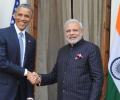
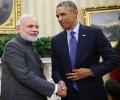
Issues related with intellectual property rights, including piracy of films and software, figured prominently during the India-US CEO Forum in New Delhi attended by Prime Minister Narendra Modi and US President Barack Obama.

'India will soon have the world's largest and youngest population -- just imagine what tomorrow's citizens of India will be able to accomplish, given the right education, training, and opportunity.'

Biden, the first US Vice President to visit India in three decades, welcomed relaxation of foreign direct investment norms in certain sectors but said a lot more needed to be done to remove trade barriers.

PM Modi said that all countries should wipe out all terror havens.

Biden said, "One of the reasons why President Obama called our relations with India, quote, "a defining partnership of the century ahead" is that India is increasingly looking east as a force for security and growth in Southeast Asia and beyond."
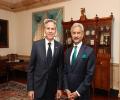
India and the US agreed to continue their cooperation in the areas of defence, space and clean energy as External Affairs Minister S Jaishankar met Secretary of State Antony Blinken here, amid a simmering diplomatic row between India and Canada over the killing of a Khalistani separatist.
Even as India continues on the priority watch list of the Office of the US Trade Representative, strong voices from Washington, DC, have spoken out in favour of India, reports Aziz Haniffa/Rediff.com.

'One of the great assets that India has is its enormous intellectual content, enormous intellectual developmental content, and some of the things we need to be working on are unmanned systems, for example, the enormous opportunities for us to jointly partner and develop -- not simply sell our equipment to India -- but actually partner and develop in areas like drones, areas like advanced aircraft and even areas around certain missile systems, where we can have a win-win.'
'India is going to maintain its ties to China, India is going to develop a strong relationship with the United States. It means that India is going to have the flexibility to pick and choose its friends.' 'That's traditional Indian foreign policy, and it's smart.' Former US ambassador to India Frank Wisner, one of America's sharpest minds on South Asia, tells Aziz Haniffa/Rediff.com what Washington can expect from Narendra Modi's visit.

'What is the ISI doing and why can't they understand for their own interest that bringing stability to the region will help all the countries become prosperous, whereas a continuation of incitement will only lead to misery for all.'
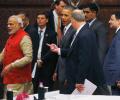
PM promised a tax regime that is predictable and competitive
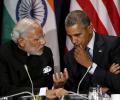
'Big countries do not agree on every set of issues.' 'Look, one of the differences in the relationship is that when we do not agree, we are sitting down and talking to each other.'

US Ambassador Richard Verma's tips to the Indian states.

Modi's visit to some developed countries such as the US, Japan, China and Australia were sprinkled with humongous investment figures. But do we have the wherewithal to absorb such big investments?
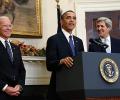
'The threat that India faces and the threat the United States faces is not just to the homeland, but to our people and to our institutions wherever they may be.' In an exclusive conversation with Aziz Haniffa/Rediff.com, US Assistant Secretary of State Nisha Desai Biswal outlines the importance of Prime Minister Modi's visit for America.

This is the joint statement issued by the ministry of external affairs on the visit of US President Barack Obama to India.

US Congresswoman Tulsi Gabbard, newly elected co-chair of the influential Congressional Caucus on India and Indian-Americans, discusses her vision for US-India ties with Rediff.com's Monali Sarkar.

What did Narendra Modi tell former Utah governor Jon M Huntsman when he met him? Aziz Haniffa/Rediff.com reports from Washington, DC.

'It is vital we should form an international coalition against ISIS, because their brutality and the use of the Internet for jihadist activities is a reminder that the entire world community has to be in this together,' US Congressman Ed Royce, chairman of the House Foreign Affairs Committee, tells Aziz Haniffa/Rediff.com in an exclusive interview ahead of Prime Minister Modi's visit.

'The US wants Modi to succeed because we want India to succeed. For our part, when India thinks of its partners in the world, we want it to think of the US first. That means positioning our country as the preferred provider of the key inputs that can help to propel India's rise.' 'The meeting between Modi and Obama is, and must be, an opportunity for true strategic dialogue -- not a scripted exchange of talking points, but an open discussion of the big questions. What kind of world do we want to live in? What are our true priorities? And most importantly, why does this partnership still matter?'

'In the past the US has been reluctant to name Pakistan directly in an US-India joint statement.'

'It is in the interest of both sides that the visit of the US President is seen as being successful. Both sides have invested considerable political capital in it. This rapid exchange of visits and the decisions taken have to be justified, beyond the symbolism, which is no doubt important in itself. This opportunity to impart a fresh momentum to ties should not be missed,' says former foreign secretary Kanwal Sibal.

'There shall be no change in India-Japan ties,' predicts Rajaram Panda.

'India is no longer the India of the '70s and the '80s.' 'It's a large country with the fastest growing economy.' 'In working with India, you just can't go and humiliate the nation publicly.' USIBC President Mukesh Aghi tells Aziz Haniffa/Rediff.com about how he advises American companies to do business with India, what he thinks of Modi's government and the way forward for the India-US relationship.

The landmark civil nuclear deal sealed on Friday with Japan is strikingly similar to the agreements India has with the US and some other countries but contains some added features on safety and security, reflecting Japan's concerns on the issue.

'If there were no Ahmedabad programme -- no flashy town hall event in a huge cricket stadium with thousands cheering him on -- then Trump may well have decided not to go to India.'

'We have a common way of looking at the world, a common way of thinking, and a common set of values that predispose us to be partners. And our interests overlap greatly,' Dr Ashton B Carter, America's next defence secretary, told Aziz Haniffa/Rediff.com in an exclusive interview.
